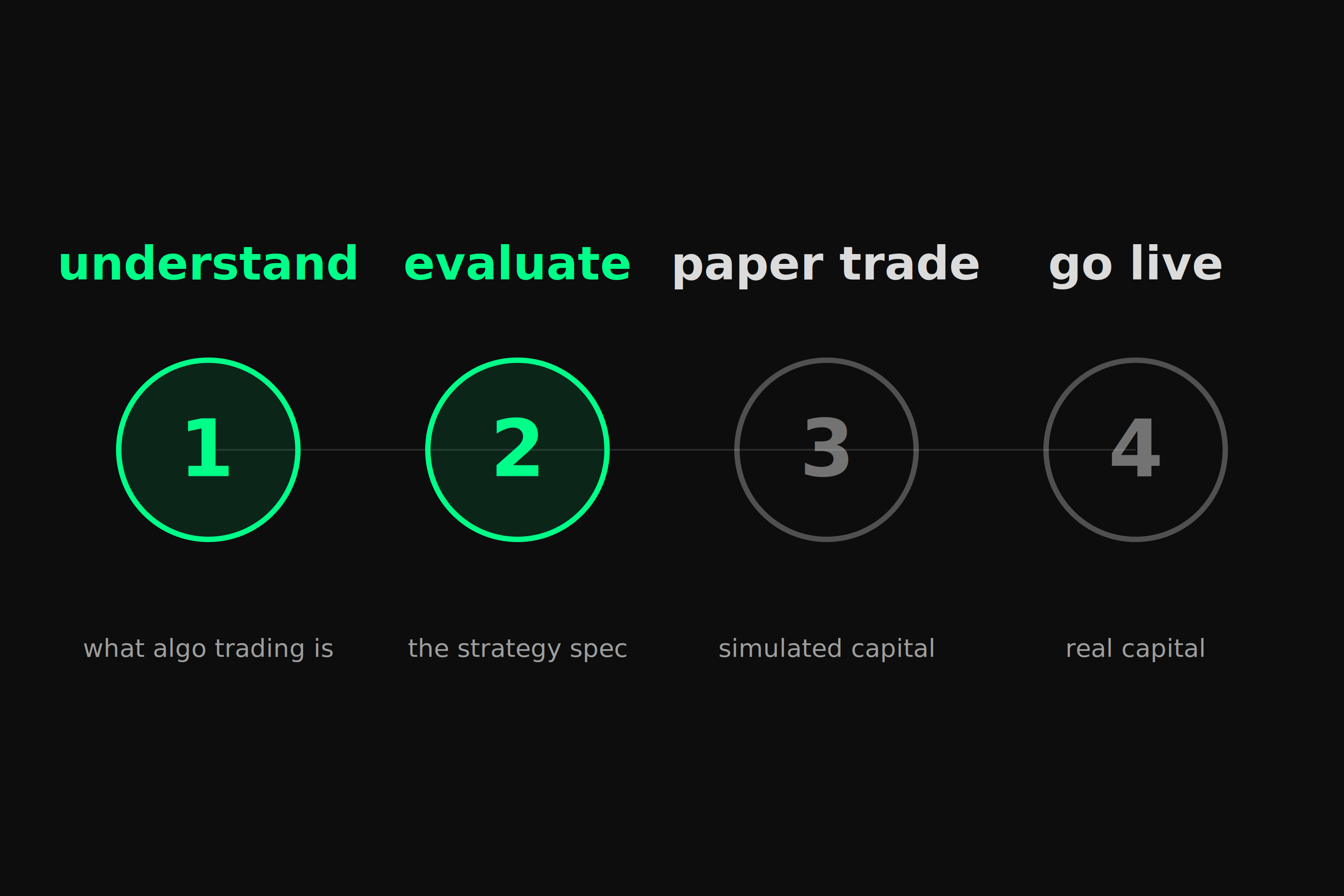
algo trading means running a strategy that executes automatically based on pre-defined rules — your job is to evaluate it before running, not manage each trade.
before running any strategy, look for four things: a plain-language description of the edge, a complete performance and risk profile, a drawdown profile, and a minimum account size.
two valid paths to start: paper trade to learn the strategy's rhythm without real money on the line, or go live directly if you've evaluated thoroughly and are sized at the strategy's minimum or above. behavior is the early diagnostic, not p&l.
For most of trading history, systematic strategies were institutional tools. You needed the technology to build them, the capital to run them at meaningful scale, and the infrastructure to execute them. None of that was accessible to most retail traders. What's changed in the last few years is the infrastructure — it's now possible to build and test a systematic strategy and run it directly in a retail brokerage account, so a retail trader can run one without building it themselves. That changes the question from "how do I build an algo strategy?" to "how do I evaluate and run one?"
This article is about the second question. If you're new to algo trading — or you've heard the term but aren't sure what running one actually involves — this is the starting point. By the end you'll understand what an algo strategy is, what to look for before you run one, how to start, and where to go deeper.
What is algo trading and how is it different from trading manually?
An algo strategy executes trades automatically based on pre-defined rules. The strategy specifies what to buy or sell, when to enter and exit, and how to size positions. Once running, it executes without requiring a decision on each trade. The defining feature is that it's systematic: the same conditions produce the same response, every time, without discretion.
That's different from how most retail traders operate. Manual trading — even when informed by a consistent approach — involves a decision at each trade. Systematic trading removes that decision layer. The strategy either fires or it doesn't, based on the rules. That consistency is both the strength and the adjustment. You don't intervene on individual trades. Your job is to evaluate the strategy before running it, monitor whether it's behaving as expected, and decide when to stop it — not to manage each position.
It's worth being clear about what algo trading is not. It's not guaranteed to outperform. It's not a black box that does your thinking for you. And it's not just for technical traders — running a strategy you didn't build yourself doesn't require knowing how to code. What it does require is understanding enough about how the strategy works to evaluate whether it's right for you and to hold through normal drawdowns without second-guessing every losing trade.
Why are retail traders able to run algo strategies now when they weren't before?
The infrastructure now exists. Connecting a systematic strategy to a retail brokerage account — so that it executes automatically without manual intervention — was technically complex and inaccessible to most retail traders until recently. The technology that handles that connection, combined with strategies built and tested specifically for retail accounts, has changed the access equation. A retail trader with a funded brokerage account can now run a professionally built systematic strategy without writing a single line of code.
The other change is on the strategy side. Strategies often hit a ceiling at institutional scale because of market impact — the fund's own order flow moves the market. At retail account sizes, that problem largely disappears. Designing for retail opens up instruments and approaches that institutional scale forecloses. The result is systematic strategies built specifically for retail deployment. On Wick, every strategy is built in-house and tested under realistic retail conditions — out-of-sample testing, real cost modeling, and a live seasoning period — before it's offered. Once live, performance data from actual execution accumulates over time, building a real-world track record alongside the backtest.
the question used to be "how do I build an algo strategy?" for retail traders, it's now "how do I evaluate and run one?"
What should you look for before running an algo strategy?
Four things:
- A plain-language description of the edge — what market inefficiency the strategy is exploiting and in what conditions. If you can't understand what the strategy is waiting for, you're picking on numbers alone, with no way to judge whether the thesis makes sense to you.
- A complete performance and risk profile — returns (total return, CAGR, win rate), risk (drawdown, Sharpe, Sortino), trade statistics (avg win, avg loss, profit factor), and benchmark comparison (alpha, info ratio). Backtest data with realistic assumptions (slippage and commission included) is the foundation; live performance data accumulates on top as the strategy runs.
- A drawdown profile — not just the maximum drawdown, but what typical drawdowns look like and how long they tend to last.
- A minimum account size — the smallest account at which the strategy can size positions as designed.
What's the right way to start running an algo strategy?
Two valid paths. You can paper trade first — running the strategy with simulated capital so you can observe how it behaves in real market conditions before committing real money — or go live directly if you've evaluated the strategy thoroughly and are sized at the strategy's minimum or above. Both are reasonable starting points. The right choice depends on how confident you are in your evaluation and whether you want to learn the strategy's rhythm in simulation before real capital is involved.
All investing involves risk of loss, including possible loss of principal. Nothing in this article constitutes personalised investment advice. Before committing real capital to any strategy, carefully review its full performance and risk profile, understand the conditions under which it is expected to underperform, and set a stopping rule before you start.
Paper trading is useful for developing a feel for the strategy's rhythm: how often it trades, what typical winning and losing periods look like, and whether early drawdowns sit within the range the spec describes. A paper window is usually too short to validate the full drawdown profile — that takes a longer track. The limitation is that it doesn't carry the same psychological weight as real capital — the decisions that feel easy on paper often feel different when real money is involved.
Going live directly is a reasonable choice if you've done the evaluation work — understood the edge, reviewed the performance and risk profile, and committed to a drawdown profile and stopping rule before any capital is at stake. The trade-off is that you're learning the strategy's rhythm under real-money conditions, which adds psychological friction during the first drawdown. Whichever path you pick, sizing matters most: most strategies specify a minimum account size, and running at or above that threshold keeps the position sizing intact and the risk profile aligned with what you evaluated. Going live at a fraction of the minimum tends to distort both.
Once you're running, behavior is the early diagnostic — whether the strategy is executing trades consistent with its stated logic, with the right instruments, sizing, and timing. Performance reads come later, once the trade sample is large enough that variance doesn't dominate. For most retail algo strategies, behavior is what you can read first. For a fuller framework on how to evaluate a strategy once it's running, the Algo Trading 101 course covers the mechanics in depth.