
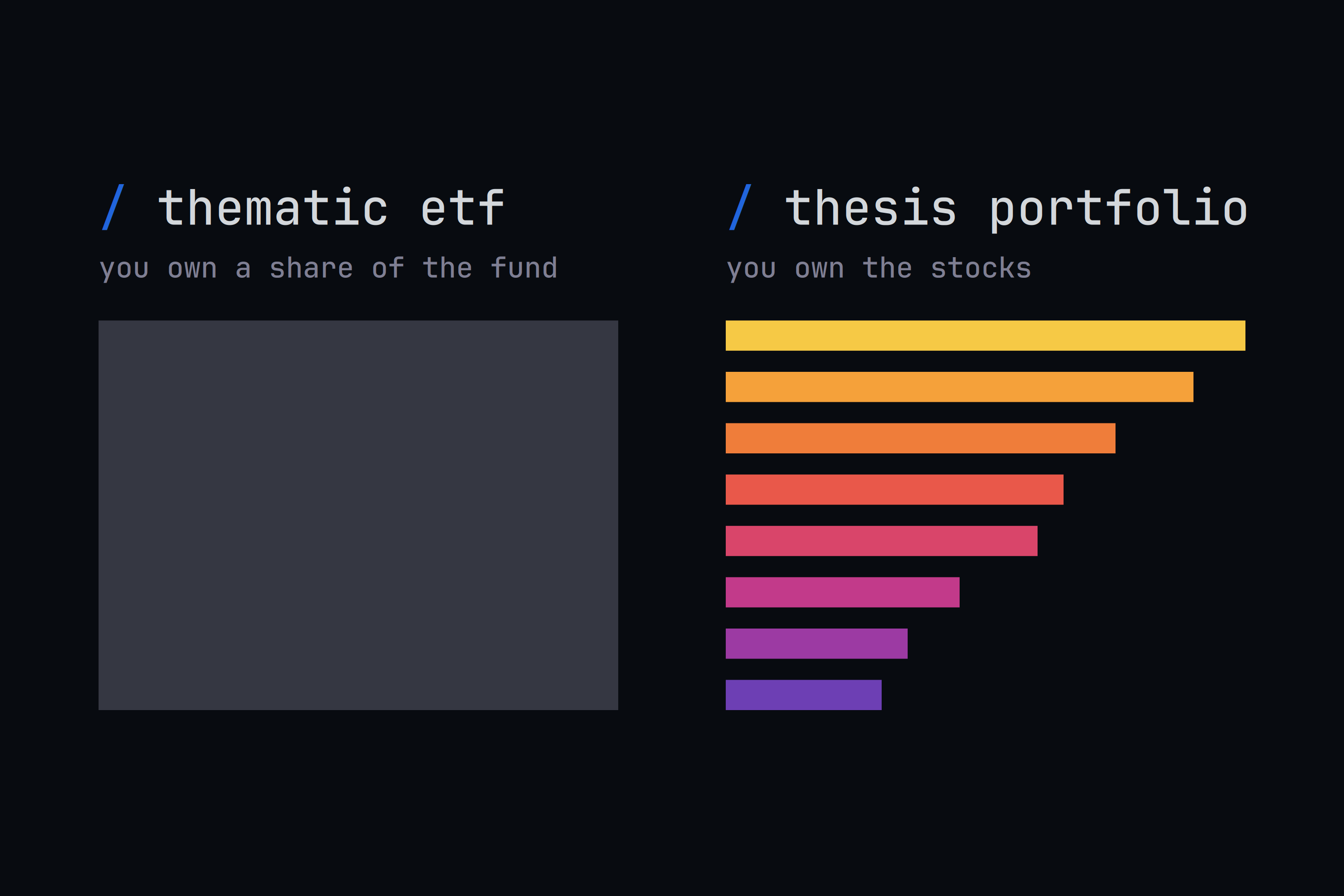
a thesis portfolio starts with a view. the names and the weights exist to express that view, and both are visible before you decide anything. one view can be expressed more than one way, so which portfolio you hold matters as much as which thesis you hold.
an etf holder owns a share of a fund that owns the stocks. you own the stocks, in an account in your name. tax, proxies and what happens when you leave all differ for that one reason.
construction is about expression, not outcomes. weighting decides how cleanly an idea is expressed, not whether the idea is right.
You think robotics improves faster than the market expects. Turning that into a position is harder than arriving at it. A single stock makes the outcome depend on one company's execution rather than on the idea. A thematic fund gives you the subject but someone else's reading of it, and what you hold is a share of the fund rather than the companies. A thesis portfolio is the third option.
What is a thesis portfolio?
A thesis portfolio is three things: a stated investment view, the names selected to express it, and a target weight for each name. It is not a fund and not a product wrapper. When you buy one, you buy the individual shares at those weights, and they sit in an individually owned account rather than in a pool with other investors.
Take a claim like this one: robotics will outperform the broader market over the next decade because the underlying technology is improving faster than the market is pricing in. That is the first part, and it is what the rest of the portfolio answers to. It sets out what has to be true for the view to hold, and it gives you something specific to disagree with, which a ticker does not.
The names are the second part. Each one is in the portfolio because of something specific about its business and the claim, not because it sits in the same sector or the same index. A company can be in the right industry and still not express the view.
The weights are the third part. Weighting is about exposure and risk: how much of the money sits in each name, and how much of the portfolio's risk that name carries. Those are not the same thing, since a volatile name at a tenth of the money can carry a quarter of the risk. The same ten names weighted two ways are two different investments.
It is also run rather than handed over. The portfolio arrives as a set of target weights, and an adviser holds discretion to place the trades that establish those weights in your account and to keep them there as prices move. You are not given a list to execute yourself, and you are not buying a fund that someone else executes inside. The shares are yours and the trading is done on your behalf.
That matters because weights are targets rather than a one-time purchase. Prices move, so the weights drift: the names that have risen most become the largest positions and the ones that have fallen shrink. Left alone, a portfolio ends up positioned by recent price moves rather than by the thesis it was built to express. Rebalancing restores the stated weights on a defined rule, and how often it happens is a design choice rather than housekeeping, because every rebalance trades fidelity to the weights against turnover and the tax that turnover creates.
Why can one thesis produce different portfolios?
A thesis is a claim about what will happen. It doesn't tell you which companies to hold, and there is more than one defensible way to answer that. Each answer is a different portfolio, and each is really a sharper view of its own: not just robotics, but robotics plus a position on where the value accrues.
On that robotics view, owning the builders assumes the companies making the machines capture the value, which requires them to execute and to hold margin against each other. Owning the suppliers assumes the value accrues to the inputs, which pays on volume whichever builder wins and arrives diluted by whatever else those suppliers sell into. Owning the adopters assumes the benefit lands as margin expansion in the businesses using the technology, which can pay even while every robotics stock looks expensive.
Within any one of them, concentration is the next question. A single name carries the full weight of company-specific risk, so a correct read on the theme can still be lost to a bad quarter, a failed ramp or a change of management. Holding more names spreads that risk, and it usually dilutes the view at the same time, because most theses have only a few companies whose whole business is the idea. The names added after those are ones with other businesses attached. Neither direction is a mistake. The trade is company-specific risk against how pure the exposure stays.
How is a thesis portfolio different from a thematic ETF?
An ETF holder owns a share of a fund that owns the stocks. With a thesis portfolio you own the stocks, in an account in your name. Tax treatment, proxy voting and what happens when you leave all differ for that one reason.
The trade cuts both ways. A fund's structure handles gains better than direct ownership does, and direct ownership handles losses better than a fund.
| thematic etf | wick | |
|---|---|---|
| who owns the stocks | The fund owns them. You own a share of the fund. | You own the companies, in an account in your name. |
| when one drops | The fund can sell it, but the loss stays on the fund's books and never reaches your tax return. | We sell it and buy a comparable name, and the loss may offset gains on your tax return.* |
| when one gains | The fund can swap holdings with institutions without recognising a gain, so it distributes little. | A sale at a gain is taxable to you that year. |
| what you can see | The fund publishes what it holds, and an index fund publishes its methodology. The trades that produced the position are the fund's, and there is no stated case for any individual holding. | Every trade in your account as it happens, plus how the names were selected, how the weights were set and how the thesis was tested. |
| who votes the shares | The manager votes them under its own policy, the same way for every holder. | The proxies are yours. You vote the companies you hold. |
| if you leave | You sell or transfer the fund position. The holdings move together. | You keep them, transfer them, or sell them, one name or all of them.** |
* Tax outcomes depend on your circumstances and on wash sale rules. Wick does not provide tax advice.
** Whole shares transfer. Fractional shares are sold and the cash moves.
A fund publishes its holdings, usually daily, and stops there. It doesn't publish the case for any individual holding, how the weights were arrived at, or what the construction was tested against, and the trades that built the position are the fund's rather than yours. Hold the shares directly and the executions are yours too, alongside the record of how the portfolio was assembled. That is transparency about the process rather than the result, which is the kind that can be audited.
The gains column is the honest cost of direct ownership. A fund's in-kind redemption mechanism lets it move appreciated stock off its books without triggering a taxable event, which is a structural advantage no separately held portfolio can reproduce. What a separately held portfolio can do is the opposite trade: when a position falls, the loss belongs to you and can be put to work against gains elsewhere in your return. A fund's losses belong to the fund.
What does a thesis portfolio not do?
It doesn't guarantee results. Construction is about expression, not outcomes: a wrong thesis is not something a weighting can offset, and no weighting determines whether a correct one makes money, or when. If you don't hold the view, no amount of care in the build makes the portfolio a sensible thing to own.
It also doesn't remove the market. Every equity portfolio moves with the broader market and a thesis portfolio is no exception. What matters is the residual once the market's move is accounted for, because that is where the thesis actually lives. It is a measurable quantity and it should be published rather than inferred. A portfolio whose returns are almost fully explained by the index is not expressing much of a view, whatever it is called.
do you believe the thesis. then, is this a defensible way to express it. the first is yours to answer. the second should be shown to you rather than asserted.