algorithmic trading runs a strategy on pre-defined rules that decide what to trade, when to enter and exit, and how much — and executes automatically without you approving each trade.
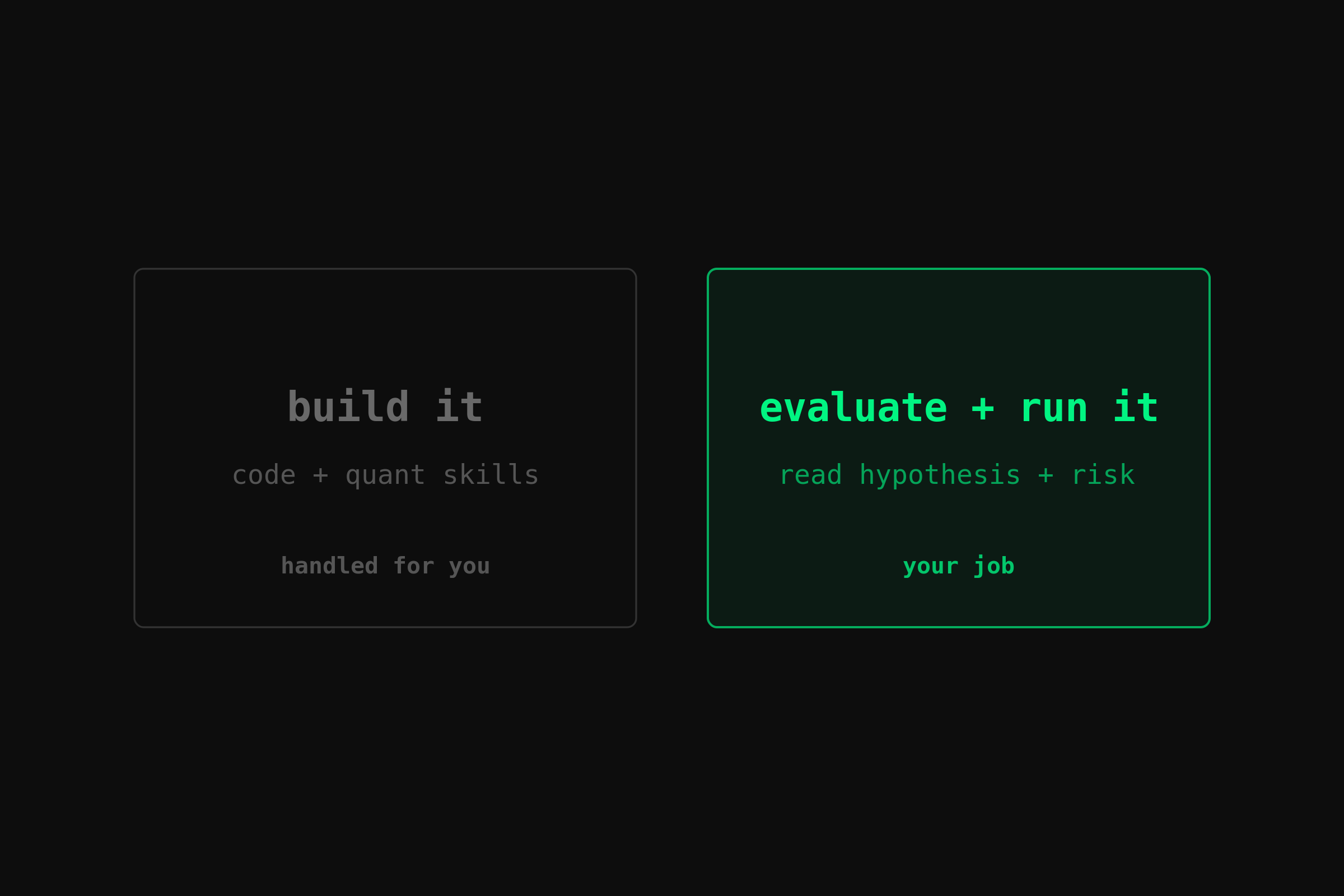
because the infrastructure to run a systematic strategy now exists inside a retail brokerage account, your job is to evaluate a strategy rather than build one.
the way to start is to evaluate a strategy's hypothesis, performance and risk, drawdown, and minimum account size, then paper trade it or run it live at that minimum or above.
Algorithmic trading is a way of trading where a set of pre-defined rules decides what to buy or sell, when to enter and exit, and how much to trade — then executes those trades automatically, without you approving each one.
For most of trading history, that kind of systematic trading was an institutional tool. Running it took the technology to build a strategy, the capital to run it at scale, and the infrastructure to execute it — none of which was within reach for most retail traders. What's changed in the last few years is the infrastructure: it's now possible to run a systematic strategy directly in a retail brokerage account without building it yourself. That shifts the question from "how do I build a trading algorithm?" to "how do I evaluate and run one?"
This article answers the first-step version of that: what algorithmic trading actually is, how it differs from trading by hand, whether you need to code, how it relates to "trading bots," and what starting looks like.
What is algorithmic trading?
Algorithmic trading is trading run by an algorithm — a fixed set of rules that specifies what to trade, when to enter and exit, and how to size each position, and then executes automatically. The defining feature is that it's systematic: the same market conditions produce the same response, every time, without discretion.
An algorithm here is just a precise set of if-this-then-that rules. A strategy might say, in effect, "when these conditions appear in this instrument, take this position at this size; exit when these other conditions appear." Once it's running, it acts on those rules as the conditions occur — you're not clicking buy and sell on each trade.
The rules can be simple or complex, but the principle is the same across all of them: the decision-making is defined in advance and applied consistently, rather than made fresh in the moment on each trade.
How is algorithmic trading different from trading manually?
Manual trading involves a decision on each trade; algorithmic trading removes that decision layer. The strategy either fires or it doesn't, based on its rules — so your role shifts from managing individual positions to evaluating a strategy before you run it and monitoring whether it behaves as expected.
Most retail traders operate discretionarily: even with a consistent approach, there's a judgment call at each entry and exit. Systematic trading replaces those repeated judgment calls with one upfront judgment — is this strategy sound, and is it right for me? After that, consistency is the point. You don't intervene trade by trade, which removes a category of in-the-moment, emotionally driven decisions. The trade-off is that it asks you to hold through normal losing stretches without second-guessing every red trade.
Do you need to know how to code to trade algorithmically?
Not if you run a strategy someone else built. Building a strategy from scratch typically takes coding and quantitative skills, but running a professionally built one in your brokerage account doesn't require writing a line of code.
This is where the old assumption trips people up. "Algorithmic trading" sounds like something reserved for developers, and building strategies genuinely is technical work. But running one is a different job. The technical part — connecting a systematic strategy to a brokerage account so it executes automatically — is handled by the infrastructure, not by you. Wick is an algorithmic trading platform built around exactly this split: every strategy is built and tested in-house, and a retail trader with a funded brokerage account can run one without building it themselves. Your work is evaluation, not engineering.
Is algorithmic trading the same as a trading bot?
They overlap but aren't the same thing. "Trading bot" loosely describes any program that places trades automatically, while a well-defined algorithmic strategy comes with a documented hypothesis, tested performance, and a stated risk and drawdown profile.
The label matters less than what sits behind it. Plenty of "trading bots" marketed online promise returns while telling you little about how they work or what a losing stretch looks like. A strategy worth running is the opposite: you can read what market behaviour it's trying to exploit, see performance and risk figures with realistic assumptions, and know roughly what a normal drawdown looks like before you commit any money. When you're comparing options, judge them on that transparency — not on whether something calls itself a bot, an algo, or a strategy.
How do you start algorithmic trading?
You start by evaluating a strategy, not building one. Look for a clear description of its hypothesis, a full performance and risk profile, a drawdown profile you can live with, and a minimum account size — then either paper trade it or run it live at or above that minimum.
Those four things are what let you judge a strategy honestly. The hypothesis is what the strategy believes about the market — the inefficiency it's trying to capture — in plain language. The performance and risk profile covers returns and risk together — including drawdown, not just upside — ideally with realistic cost assumptions and live results accumulating over time. The drawdown profile tells you what a typical losing stretch looks like and how long it tends to last, so a rough patch in week three doesn't feel like a surprise. And the minimum account size is the smallest balance at which the strategy can size positions as designed.
From there, paper trading lets you watch a strategy behave in real conditions without real money on the line, while going live directly is reasonable if you've done the evaluation and can fund at least the minimum. Either way, once it's running, behaviour is the first thing to read — whether it's trading the right instruments at the right sizes — because a small number of trades is too noisy to judge performance from.
Wick's companion guide, "how to start algo trading," walks through that evaluation framework in more depth.