
China stimulates its economy
China remains the largest buyer of copper, iron ore, aluminium and other industrial commodities, and its demand is driven by construction, infrastructure and manufacturing activity. When Beijing steps up stimulus for those sectors, Chinese purchasing rises, prices firm, and volumes grow for the producers that supply the raw materials and for the companies that sell machinery, mining equipment and industrial components into China. The size of that policy lever is what makes the theme matter: a change in Chinese fiscal or credit support moves global commodity markets. Portfolios under this thesis select miners of copper, iron ore and related metals, along with industrial exporters whose sales to China or to China-driven commodity markets are a material share of earnings. Manufacturers whose costs rise with commodity prices, and companies with only incidental exposure to Chinese demand, are excluded.
Rio Tinto is a diversified base-metal miner whose earnings are dominated by the three metals the thesis names. fy2025 underlying EBITDA of $25.4bn split iron ore $15.2bn, copper $7.4bn and aluminium & lithium $4.6bn, so iron ore, copper and aluminium are roughly 95% of segment EBITDA, with lithium, borates, iron & titanium and diamonds minor. Greater China took 57.3% of 2025 consolidated sales revenue ($33.0bn of $57.6bn), almost all Pilbara iron ore sold to Chinese steel mills, and the company runs a portside blending business inside China. revenue is realized price times volume on a largely fixed cost base, so a China-driven iron ore or copper price move passes almost fully to earnings — the direct producer mechanism in this portfolio's angle. not quite 1.0 because the Arcadium lithium acquisition, aluminium's partly non-China end markets and minor minerals dilute the pure iron ore and copper exposure; near pure play at 0.9.
Vale is the world's largest iron ore and pellet producer, with a smaller base-metals arm (nickel, copper). the FY2024 20-F puts iron ore and pellets at 80.7% of net operating revenue (US$31.4bn of US$38.1bn) and customers in China at 49% of revenue; the remaining ~17% is nickel and copper, also industrial metals in the thesis list. earnings are realized iron ore price times shipped tonnes against a largely fixed cost base (C1 cash cost ~US$23/t), so a China-driven move in the seaborne iron ore price passes almost fully to operating income — the Q3 2026 print shows realized fines price down 10% to US$85/t on weaker China demand expectations. for the metal producers angle this is the thesis itself; the small haircut from 1.0 reflects the nickel business, whose price is set more by Indonesian supply and EV demand than by Chinese fixed-asset investment.
construction analyst: the fy2025 10-k puts copper at 75.9% of revenue with molybdenum 10.9%, zinc 3.6% and silver 5.7%, and the researcher's own caveat notes silver has run to 6-12% of recent revenue. a name with up to a tenth of revenue in a monetary metal is not a 1.0 on the same scale that gives fcx 0.9 for 75% copper and 15% gold. set 0.9: copper plus industrial by-products are roughly 90% of the business, which keeps it comfortably above the pure floor.
Freeport-McMoRan is one of the three largest copper miners globally, with stakes in 10 copper mines (Grasberg, Cerro Verde, Morenci and seven other us and south american operations) plus two molybdenum mines. 2025 consolidated revenue was 75% copper, 15% gold and 8% molybdenum, so three quarters of the business is a direct base-metal producer whose realized price is set on LME and COMEX — markets where China is the marginal buyer. earnings leverage is the mechanism the thesis needs: management guides roughly $390m of annual EBITDA per $0.10/lb move in copper on 2027–2028 volumes against a largely fixed cost base. the gold stream (15%, almost all from Grasberg) is monetary-metal pricing and outside the thesis, and direct sales into China are only about 2–3% of revenue, which is why this is 0.9 rather than 1.0 — but for the metal producers angle it is close to a pure play.
Teck Resources is a copper and zinc miner (Highland Valley, Quebrada Blanca, Antamina stake, Red Dog, Trail smelter) after selling oil sands in 2023 and steelmaking coal in 2024. FY2025 revenue of C$10.8bn split copper C$5.8bn (54%), zinc C$3.0bn (28%), with silver, lead, molybdenum and germanium by-products making up the rest; copper carried roughly 80% of gross profit in Q2 2026 and Q3 2026 profit rose more than fivefold on record copper prices. China was the largest single destination at C$2.6bn (about 24% of 2025 revenue), and copper and zinc pricing is globally set with China the marginal buyer. this is a direct base-metal producer whose earnings are realized price times volume on a largely fixed cost base — the thesis is what the company does. precious-metal by-products near a tenth of revenue and a 40% minority in QB keep it just below a full pure-play tier → 0.9.
Trekor Metals (formerly Taseko Mines) is a single-commodity copper producer: the 100%-owned Gibraltar open-pit mine in British Columbia and the Florence Copper in-situ SX/EW operation in Arizona, which began cathode production in early 2026. fy2025 revenue was $673m, of which copper in concentrate was $599.1m and copper cathode $11.7m — roughly 91% copper — with molybdenum by-product at $52.6m and gold at $2.1m. revenue is realized LME copper price times pounds sold against a largely fixed mine cost base, so a China-driven copper price move passes almost fully to earnings; 2026 guidance of 140-150m lb combined adds volume leverage as Florence ramps. no non-mining segments, no battery metals, no precious-metal weighting. this is the archetype of the producer leg → pure play, 1.0.
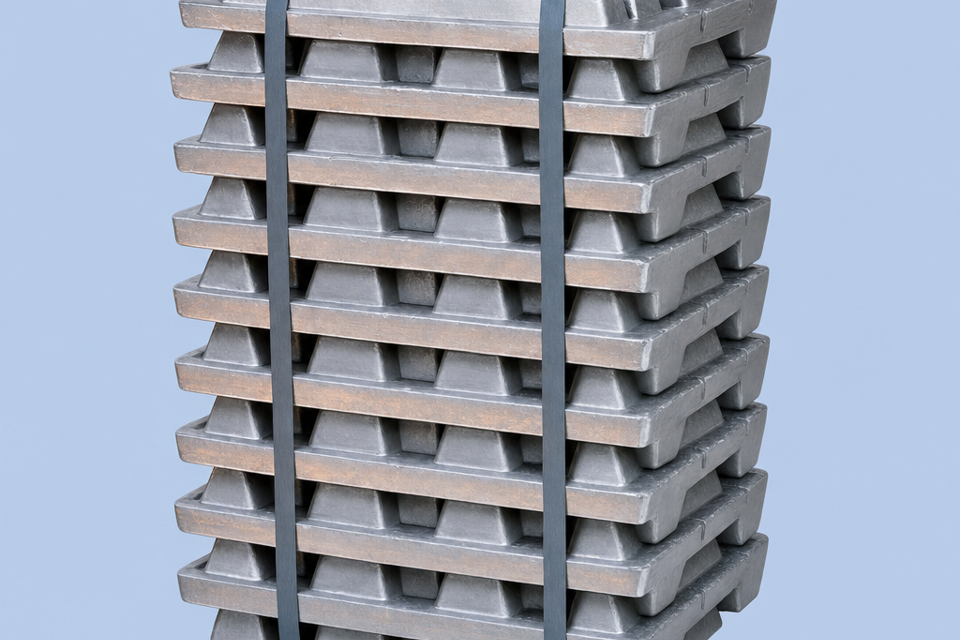
Alcoa is a vertically integrated primary aluminum producer — bauxite mining, alumina refining and aluminum smelting — with no downstream or non-metal business since the 2016 Arconic spin. the FY2025 10-K shows two segments, both commodity-priced: third-party aluminum sales of $8,515m on roughly 2.5mt shipped, priced off LME plus regional premia, and third-party alumina sales of $4,281m priced off the API spot index. every dollar of revenue is therefore a metal price times tonnes against a largely fixed smelter and refinery cost base, which is exactly the direct-producer leg of the thesis. China is the largest aluminum consumer and the dominant seaborne buyer of bauxite and third-party alumina, so a China fixed-asset stimulus that firms LME aluminum and alumina prices passes almost fully to Alcoa's earnings. pure play on the aluminum producer leg → 1.0.
Ero Copper is a Brazil-based copper concentrate producer (Caraíba underground and Tucumã open pit) with a smaller gold mine (Xavantina). fiscal 2025 revenue was $785.8m, of which copper sales were $619.7m (about 79%) and gold sales $166.1m (about 21%); Q2 2026 shows a similar split with gold at $64.9m of $284m. the copper business is exactly the producer leg of the thesis — revenue is realized copper price times tonnes shipped against a largely fixed cost base, so a China-driven copper price move passes almost fully to earnings. the gold mine is an excluded monetary-metal exposure and its share has grown with the gold price and the start of gold concentrate sales, which keeps the name below pure play. no China customer share is disclosed; exposure runs through the global copper price. tier 0.8 — copper-dominant producer with a material non-thesis gold sleeve.
Century Aluminum is a single-segment primary aluminium smelter — Sebree and Mt. Holly in the US and Grundartangi in Iceland, ~770kt capacity, ~638kt produced in 2025 — plus a 55% stake in the Jamalco alumina refinery and an anode plant that feed the smelters. revenue is LME aluminium plus regional and product premiums against a largely fixed power, alumina and carbon cost base, so earnings move almost one-for-one with the global price that Chinese demand sets at the margin; the FY2025 10-K calls operating results highly sensitive to the LME price. the business is 100% the metal the thesis names, which argues for the pure tier. the haircut to 0.8 reflects that a sizable slice of realized price is the US Midwest premium, which is set by Section 232 tariffs rather than Chinese buying, and that ~70% of Grundartangi power cost is LME-linked, muting leverage there. no sales into China — exposure runs entirely through the global price.