
Hormuz stays closed
The Strait of Hormuz carries around a fifth of the world's seaborne oil and a large share of its liquefied natural gas. This thesis assumes the Iran conflict keeps that passage restricted, through attacks, blockades or insurance costs that make transit impractical, whether or not a ceasefire is declared. With Gulf barrels and cargoes stuck, crude and gas prices stay elevated and buyers turn to supply from the Americas, the North Sea, Africa and Australia, lifting the revenue of producers in those regions. A portfolio under this thesis selects oil and gas producers whose output sits outside the Gulf, from large integrated companies to shale and offshore operators, and adds tanker owners only where redirected cargoes and longer voyages raise their freight rates. It excludes airlines, chemical makers that buy oil-based feedstock, and any company with meaningful Gulf operations, since each is hurt rather than helped by the disruption.
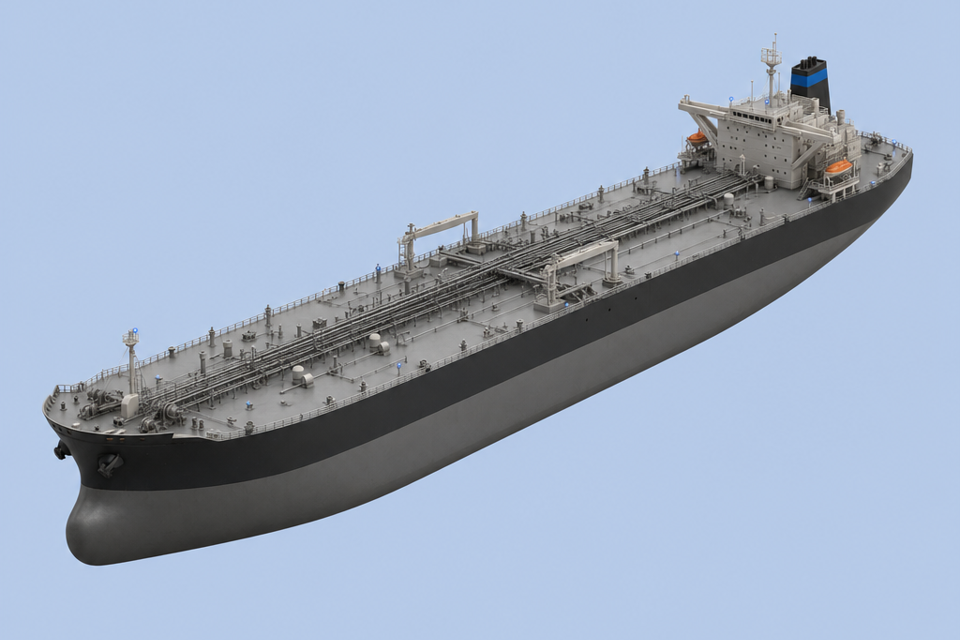
DHT Holdings is a single-segment crude tanker owner: 23 VLCCs as of March 2026, earning voyage (spot) and time charter revenue, with a small technical-management sideline. that is the portfolio angle in full — a crude tanker owner whose earnings move with spot VLCC rates and war-risk premia. the thesis is already visible in results: Q1 2026 spot TCE $91,700/day vs $36,300/day a year earlier, Q2 2026 spot days booked at $168,300/day, and independent fixture reports show DHT vessels loading in the Gulf of Oman at seven-figure daily rates in October 2026. spot exposure was 57% of revenue days in Q1 2026, with newer one- and three-year charters fixed at $100,000–109,000/day locking in conflict-level pricing. held at 0.9 rather than 1.0 because roughly 40% of days are on fixed charters and the company's own commentary notes ~10% of the global VLCC fleet is tied up inside the Middle East Gulf, so fleet position is shown only partially.
Enterprise Products Partners is a us midstream mlp (market cap about $82bn) running ngl, crude, natural gas and petrochemical pipelines, processing, fractionation and gulf coast marine terminals. q3 2026 gross operating margin was $2.7bn, split ngl $1,535m · crude $367m · natural gas $411m · petrochemical and refined products $430m. the thesis-relevant piece is the export chain: marine terminal volumes ran 2.5 mmbpd (ngl 1,196 mbpd, crude 926 mbpd), it operates the largest lpg export facility in the world with a 300 mbpd expansion due by year-end 2026, and ngl marketing margins rose on export-linked strategies as hormuz closure pushed asian lpg buyers toward us cargoes. that is a direct export-leveraged midstream channel, but the majority of cash flow is fee-based domestic pipeline, gathering and processing that moves little with brent or spot lng — material exposure, not a pure play, so 0.6 under this portfolio's angle.
Cheniere owns and operates the Sabine Pass and Corpus Christi liquefaction terminals on the US Gulf Coast — about 55 mtpa, the largest US LNG producer, and essentially its entire business, with no Hormuz-side assets. that is exactly this portfolio's angle, so by business mix it is a pure play. the brief's earnings channel is narrower: most volume is sold under long-term Henry Hub-linked fixed-fee SPAs (about 46.5 of 53–54 mt in 2026, 52 mt in 2027), leaving roughly 5 mt a year of spot and marketing volume to reprice to JKM/TTF, and management puts the sensitivity of consolidated EBITDA to a $1/MMBtu margin change at under $50m against 2026 guidance of $7.9–8.4bn. the mid-2026 guidance raise after Hormuz LNG flows collapsed shows the channel is real but modest. tier 0.8 — pure by business, muted by contract structure.
Teekay Tankers owns and operates a mid-size crude and product tanker fleet (33 owned plus 3 chartered-in suezmax and aframax/LR2 vessels as of May 2026), with 29 of 36 tankers trading spot and 7 on fixed-rate charters. the tankers segment produced $253.9m of $286.1m q1 2026 revenue (about 89%) and essentially all operating income; the remainder is a low-margin australian marine services contract business. both conditions for the shipping leg hold: the company states the Hormuz closure has not directly impacted its vessels (mid-size fleet trades the Atlantic basin, the single VLCC was sold in june 2026), and roughly 80% of the fleet is spot-exposed, so the longer Atlantic-to-Asia voyages and trapped tonnage flow straight into realized TCE — q2 2026 suezmax spot averaged $109,200/day, a company record. a spot-weighted non-Gulf crude tanker owner is close to a pure play on this portfolio's angle; the ~11% non-tanker revenue and a few new 10-12 month time charters keep it just under 1.0.
Vista Energy is a single-segment independent shale oil and gas producer in Argentina's Vaca Muerta, with a minor Mexico interest. q2 2026 production was 156 kboe/d, 135 kbbl/d of it oil; exports were 72% of oil sales volume and management says 100% of oil was sold at export parity, giving realized prices ($89.4/bbl in q2, up 49% sequentially) that track Brent with no Gulf exposure. no refining, chemicals or midstream to offset, so earnings move close to one for one with the Brent premium the thesis assumes — management guides roughly $200m of adjusted EBITDA per $10/bbl. for the non-Gulf upstream angle this is a pure play: 1.0.
Viper Energy owns mineral and royalty interests in the Permian Basin, operated mainly by parent Diamondback Energy. its entire income is royalty revenue on oil, gas and ngl production — q2 2026 royalty income was $658m, of which oil income was $582m (about 88%), with no operating costs or capex. production is wholly in west Texas and New Mexico, so there is zero Gulf exposure, and realized oil moved from $73.16/bbl in q1 2026 to $98.28/bbl in q2 2026 while volumes held at about 65,000 bo/d — exactly the price-without-volume-loss channel the thesis describes. a royalty structure gives higher operating leverage to price than an operator because there is no cost base. against this portfolio's non-Gulf producer angle the business is the thesis: pure play.
Woodside is Australia's largest LNG producer and an integrated upstream company with no Gulf production: Pluto, North West Shelf and Wheatstone LNG in Western Australia, oil at Sangomar (Senegal) and in the US Gulf of Mexico, plus Australian domestic gas. by asset, the LNG plants plus LNG marketing generated roughly half of 2025 sales revenue (about 5.7bn of 12.8bn from the three LNG assets, plus 1.3bn marketing), oil assets about a third, domestic gas under a tenth. about 30% of produced LNG is sold on JKM·TTF·NBP hub indices and the rest is oil-linked, so both halves of the book reprice when Brent and spot LNG rise; Q3 2026 realized LNG price rose 27% q/q to 84 usd/boe. Scarborough adds LNG volume from Q4 2026; Louisiana LNG arrives after the horizon. LNG is the largest but not sole business and the spot-indexed share is a minority, so material-to-high exposure against the LNG exporter angle → 0.7.
Talos Energy is a pure upstream producer in the US Gulf of Mexico (Gulf of America), with a minority non-operated interest in Zama offshore Mexico and early-stage exploration acreage in Honduras. q2 2026 production was 93.7 MBoe/d, 73% oil, and realized oil averaged $99.47/bbl against a $92.79 WTI average — a premium that reflects waterborne gulf coast crude pricing linked to the Brent-indexed export market, which is exactly the pricing channel the thesis needs. revenue is entirely oil, gas and NGL sales; there is no refining, chemicals or tolling offset. all production sits outside the Gulf and no Hormuz-transiting volume exists. earnings move close to one for one with the realized price, so against the non-Gulf upstream angle this is a pure play at 1.0.
Patterson-UTI is a US land oilfield services contractor: contract and directional drilling, hydraulic fracturing and drill bits (Ulterra). fy2025 revenue of 4.79bn USD split 1.56bn drilling services, 2.89bn completion services, 0.34bn drilling products, with the large majority earned in the United States; contract drilling abroad was only Colombia and Ecuador, and the Colombia business is being exited. against this portfolio's angle — oilfield services in the Americas — essentially the whole business is the thesis leg, which puts it near pure play. the small deduction reflects Ulterra bit sales into Saudi Arabia and Oman plus a minority Abu Dhabi drilling joint venture, both well under the 10 percent gulf screen but a mild offset if gulf activity is disrupted. earnings sit at a ttm loss, so operating leverage to a rig and frac recovery is high but the benefit is lagged and depends on US producers reinvesting rather than buying back stock.
Frontline is a single-segment crude and product tanker owner (VLCC, Suezmax, LR2/Aframax, roughly 80 vessels) earning almost entirely from voyage and time charters, with the bulk of fleet days priced in the spot market. against the redirected-cargo shipping angle this is the thesis itself: the Hormuz closure cut Gulf crude exports sharply, pushed Atlantic-basin-to-Asia ton-miles and war-risk premia up, and FRO printed record profits in Q1 and Q2 2026 on VLCC spot TCEs above $150,000 per day. the fleet-position condition holds — only five of about 80 ships were reported stuck inside the Gulf (~6%), the rest trade worldwide on spot. held back from 1.0 because a small share of the fleet is idled inside the Gulf, part of VLCC demand normally originates at Gulf loadings, and recent one-to-three-year charter-outs trim spot exposure at the margin.
ConocoPhillips is a pure upstream independent — exploration and production only since the Phillips 66 refining spin-off, so there is no downstream offset. 2024 production was 1,987 MBOED; Q1 2026 Lower 48 alone delivered 1,453 MBOED of about 2.3 MMBOED (roughly 63%), with the rest in Alaska, Canada, Norway, Australia LNG, Libya, Malaysia and China — all basins whose exports avoid Hormuz. the only Gulf exposure is the 30% stake in QatarEnergy LNG N(3) (83 MBOED in 2024, about 4% of volume) plus 25% stakes in the North Field East and South expansions; that is well under the 10% exclusion screen and has already been stranded by the conflict (Qatar dropped from Q2 2026 guidance, about 20 MBOED annualised hit). realized-price leverage is visible in the numbers: diluted eps rose from 1.78 in Q1 2026 to 3.23 in Q2 2026 as Brent moved above 100. near pure play on the non-Gulf upstream angle; the small stranded Qatar leg keeps it just below 1.0.
Devon Energy is a pure upstream US onshore producer — Permian (Delaware), Anadarko, Bakken, Eagle Ford and, since the May 2026 Coterra merger, the Marcellus. no refining, chemicals or Gulf assets; all production sits outside Hormuz. Q2 2026 oil, gas and NGL sales were $5.1bn, with marketing and midstream revenue largely pass-through. the thesis channel is already visible: Reuters reports a Q2 realized oil price of $88.09/bbl against a Brent average of $89.62, so the WTI-Brent decoupling caveat for US onshore names is not biting, and the hedge book (tens of thousands of bbl/d of swaps and collars against ~500 kbbl/d of oil) leaves most volume unhedged. the deduction from 1.0 reflects the enlarged gas leg (oil is roughly 500 kbbl/d of 1.38 MMboe/d) priced off Henry Hub and Appalachian basis rather than global gas benchmarks, which links to the shock only through US LNG export capacity.
EOG Resources is a pure upstream crude, NGL and gas producer — SIC 1311, no refining or chemicals — with net production of roughly 1,232 mboe/d in 2025 at 69% liquids, almost entirely from US shale (Permian, Eagle Ford, Utica). the FY2025 10-K puts 99% of proved reserves in the United States and 1% in Trinidad; the Bahrain gas concession is exploration-stage with a handful of legacy wells, far under the 10% Gulf exclusion screen. earnings move near one for one with realized price: q2 2026 diluted eps of 5.15 versus 1.31 in q4 2025 tracks the Brent spike. waterborne exposure is real but partial — crude sold along the US Gulf Coast and exported at Corpus Christi, gas delivered to a Corpus Christi liquefaction plant with JKM-linked pricing at EOG's election — while the rest prices off domestic hubs. non-Gulf upstream pure play for this angle; small haircut for the Bahrain footprint and WTI-basis exposure.
Diamondback Energy is a single-basin upstream producer: crude oil and natural gas exploration and production in the US Permian Basin, with no refining, chemicals or Gulf-region assets. Q2 2026 output was 525 mbo/d and 1,018 mboe/d, essentially all of it sold at commodity prices, so earnings move almost one for one with the oil benchmark — unhedged realized oil went from $73.47/bbl in Q1 2026 to $96.82/bbl in Q2 2026 as the Hormuz disruption lifted prices, and diluted eps moved from $0.08 to $6.65 over the same two quarters. hedges are mainly long puts, so upside pass-through is largely intact (hedged $94.33 vs unhedged $96.82 in Q2). the business is wholly the thesis for this portfolio's angle — a non-Gulf oil producer — which puts it at the pure-play tier. the small discount from 1.0 reflects onshore Midland/WTI pricing rather than waterborne or Brent-linked sales, the one basis risk the brief flags for US shale, plus negligible value from gas, which realized a negative price in Q2.
International Seaways is a pure tanker owner: a 64-vessel operating fleet (67 with LR1 newbuilds) of VLCC, Suezmax, Aframax and Panamax crude tankers plus LR1, LR2 and MR product carriers, with no other business line. its 10-Q states revenues come primarily from spot voyage charters via commercial pools, so the fleet-position and spot-exposure condition for this leg is met: ton-mile gains from Atlantic-basin-to-Asia detours flow straight to tce. the channel is already visible in results — blended spot tce above $100,000/day in Q1 2026, diluted eps of $5.75 and $5.91 in Q1 and Q2 2026 versus $1.42 in Q3 2025, and Q4 2026 fixtures near $180,000/day. the Bruton deal adds four VLCCs. held below 1.0 only because roughly half the fleet is product tankers rather than crude or LNG, a related but not identical expression of the shipping angle.
Noble Corporation plc is a single-segment offshore drilling contractor — 2025 contract drilling revenue was $2,568m from floaters and $540m from jackups, nothing else of size. the fleet (25 floaters, 6 jackups at end-2025) operates in Africa, Far East Asia, the North Sea, Oceania, South America and the US Gulf, with no rigs in the Persian Gulf and no Gulf national oil company among top customers (ExxonMobil 19.7%, BP 13.2%, Petrobras 12.5% of 2025 revenue). backlog is concentrated in US Gulf (35.3%), Guyana (23.7%), Suriname (12.9%) and North Sea (11.4%) — exactly the non-Hormuz basins the brief says receive redirected demand. against this portfolio's offshore-driller angle the business is essentially 100% on-thesis; small haircut for rigs in the Philippines and Black Sea and for the fact that earnings move only as multi-year contracts reprice, so 0.9.
Transocean is a single-segment offshore contract driller — ultra-deepwater drillships and harsh-environment semisubmersibles leased with crews to operators. 10-Q disaggregation for the nine months to 30 Sep 2025 puts contract drilling revenue at $2,922m, of which U.S. $1,202m, Brazil $636m, Norway $476m and other countries $608m — roughly 79% from the US Gulf, Brazil and the Norwegian shelf, with the remainder in non-Gulf basins (West Africa, Australia, India). no rigs or revenue in the Hormuz-exposed Gulf states. against this portfolio's angle — offshore drillers in the Americas and North Sea — the business is essentially the thesis, so near pure play. small haircut because ~$6.7bn of multi-year backlog means dayrate repricing arrives with a lag of several quarters rather than in the next two prints, and ~21% of revenue sits outside the named Americas/North Sea basins.